Why White Mineral Buildup Forms On Faucets
Notice white crust on your faucets? Learn what causes mineral buildup, safe removal steps, and when to call a Fresno plumber for help.

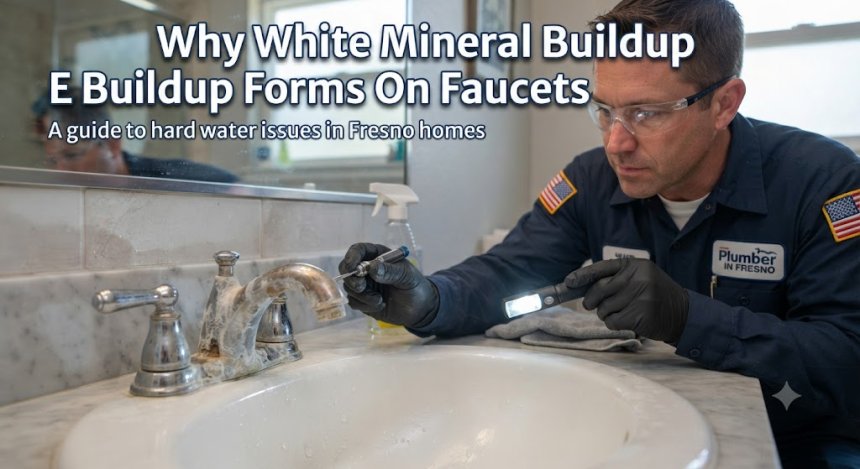
Wiping down your bathroom or kitchen sink only to find a stubborn, chalky white crust returning around the base of the handles and spout day after day is a frustrating battle. When property owners ask why is there white mineral buildup around my faucets, they are witnessing the direct visual evidence of dissolved minerals precipitating out of their local water supply. Homeowners across Fresno frequently encounter this hard water challenge due to the region's distinct geological profile, which introduces heavy mineral concentrations into the municipal water network. Ignoring this crusty accumulation does more than ruin the aesthetic of polished chrome or brushed nickel finishes; it gradually chokes internal valve cartridges, restricts water flow, and leads to premature fixture failure if left unchecked.
Root Causes: Why Mineral Buildup Occurs in Fresno Homes
Plumbing fixtures are subjected to continuous environmental and geological factors. Several specific drivers accelerate scale accumulation across Central Valley properties:
-
High Calcium and Magnesium Content: Fresno’s local water supply carries substantial concentrations of dissolved rock minerals that leave solid deposits behind as water droplets evaporate on metal surfaces.
-
Thermal Precipitation: Hot water usage speeds up chemical reactions, causing calcium carbonate to solidify rapidly and form thick, rock-hard bonds around aerators, cartridge stems, and spout bases.
-
Minor Chronic Leaks: A slow, unaddressed drip or micro-seep from a worn O-ring provides a constant supply of evaporating moisture, building up heavy crust rings around handles and escutcheon plates.
-
Aging Distribution Infrastructure: Older neighborhood water mains and residential service lines can accumulate inner-wall scale that sheds microscopic particles, aggravating surface spotting at the tap.
-
Surface Porosity and Wear: Microscopic scratches on older faucet finishes provide a secure anchoring point for mineral crystals to latch onto and multiply.
What Is Hard Water Scaling? Decoding the Mechanism
Hard water scaling is the physical accumulation of dissolved alkaline minerals left behind when water evaporates from a surface.
Imagine a typical afternoon in a home near Fig Garden: you wash your hands, and a few stray droplets cling to the base of the faucet handle. As the air absorbs the moisture, the dissolved calcium and magnesium ions bond together into a solid crystalline structure. Over weeks of daily use, layer upon layer of these crystals builds a chalky white barrier that can bind moving parts, seize handles, and clog internal mesh screens. Understanding that this buildup grows from microscopic water droplets outward explains why routine wiping is often not enough to stop hard water scaling permanently.
Critical Warning Signs: When Your Fixture is Sounding the Alarm
Recognizing the early indicators of advanced mineral scaling helps prevent total fixture lockup:
-
Stiff Handle Operation: Single-handle levers or dual-handle stems that feel tight, gritty, or difficult to turn smoothly due to scale binding the internal stem.
-
Visual Crust Ring Formations: A thick, chalky white or yellowish crust accumulating precisely where the faucet base meets the countertop or sink deck.
-
Spray Distortion: Water streams shooting out at odd angles or splitting into a wide fan because mineral flakes have restricted parts of the aerator screen.
Ignoring these warning signs leads to frozen mixing valves, cracked plastic internal components, and stubborn leaks that can seep through the countertop into the cabinet below.
Financial Breakdown: Cost Factors & Investment Realities
Addressing hard water scaling and fixture damage involves several variable cost inputs depending on the scope of work:
-
Diagnostic Dispatch Fees: Standard service call rates covering travel and professional assessment of your home's water quality and fixture health.
-
Component Versus Full Replacement: The cost delta between rebuilding a calcified valve cartridge versus replacing a high-end designer faucet assembly entirely.
-
Specialty Extraction Labor: Extra time required if severe scale has fused mounting nuts or supply lines together, demanding specialized cutting or heating tools.
-
Whole-Home Water Treatment Investment: Installing a dedicated water softener or scale-prevention system to protect all household plumbing fixtures from future mineral damage.
Professional Diagnostic & Repair Workflow
When a licensed plumber is called to evaluate heavily scaled or failing fixtures, they follow a structured methodology:
-
Step 1: Water Pressure & Source Isolation: The technician shuts off the local angle stops and checks the home's primary water pressure regulator to ensure operating parameters are normal.
-
Step 2: Non-Destructive Component Triage: The plumber inspects whether the scaling is isolated to external aesthetics or has invaded internal ceramic discs and threaded connections.
-
Step 3: Upfront Written Options: The homeowner receives clear, flat-rate pricing detailing whether descaling, cartridge rebuilding, or full fixture replacement is the most cost-effective path.
-
Step 4: Code-Compliant Remediation: The technician removes affected parts, cleans or replaces components, installs fresh seals, and ensures proper alignment without damaging the sink deck.
-
Step 5: Final Pressure & Flow Testing: The system is pressurized, checked for leaks, and tested to verify smooth handle movement and a clean, aerated water stream.
Advanced Diagnostics: The Professional Tool Arsenal
Professional plumbing technicians rely on heavy-duty equipment to diagnose the root extent of hard water damage accurately:
-
Digital Manometers: Precision gauges used to measure static and dynamic water pressure, identifying whether high pressure is exacerbating fixture wear.
-
Ultrasonic Cleaning Tanks: Commercial baths utilizing high-frequency sound waves to strip hardened calcium scale completely off delicate brass internal components.
-
Thermal Imaging Cameras: Non-invasive infrared devices that detect hidden temperature variations, blocked mixing valves, or slow leaks behind cabinet walls.
-
Borescope Inspection Probes: Miniature cameras capable of viewing the interior condition of hidden supply lines, angle stops, and manifold connections.
Unique Expert Insights: Hard Truths Homeowners Learn Too Late
-
Scrubbing chrome faucets with abrasive scouring pads or steel wool destroys the protective plating, creating rough micro-scretches that trap future mineral scale even faster.
-
Pouring industrial-strength chemical descalers down older, corroded drain assemblies can eat away at thin metal slip joints and cause sudden under-sink leaks.
-
Wrapping plumber's tape over external decorative threads to stop scale leaks is an amateur band-aid that usually distorts the collar and cracks the spout housing.
-
Ignoring a stiff, scale-locked faucet handle eventually snaps the internal brass stem, turning a simple 20-minute cartridge swap into an emergency fixture replacement.
-
Point-of-use vinegar soaking works wonders for external crust, but it cannot reverse internal metal pitting caused by years of aggressive hard water exposure.
DIY Reality Check: What You Can Safely Fix vs. When to Step Back
Homeowners can safely tackle minor external scale buildup using simple household methods. Secure a plastic bag filled with white vinegar around the faucet spout using a rubber band, letting it soak for a few hours to dissolve the crust before scrubbing gently with a soft nylon brush.
Step back and call a professional immediately if the mounting nuts underneath the sink are completely rusted or calcified solid, or if attempting to loosen supply lines causes the copper tubing to twist and kink. Forcing stuck fittings under the sink counter risks a catastrophic pipe rupture and major water damage.
Comprehensive Home Plumbing Maintenance Framework
-
Spring & Summer Checks: Test outdoor hose bibs for winter cracking, inspect main shut-off valves for smooth turning, and check under-sink supply lines for early moisture weeping.
-
Fall & Winter Preparation: Flush water heater tanks to eliminate bottom sediment buildup, insulate exposed garage pipes, and disconnect outdoor hoses to prevent freezing pressure.
-
Year-Round Habits: Wipe down faucet bases daily after use, soak aerators in vinegar every few months to prevent scale lockup, and monitor water pressure regulator performance regularly.
Emergency Protocol: When Immediate Dispatch is Non-Negotiable
Certain plumbing situations require immediate 24/7 professional intervention:
-
Sudden catastrophic failure of a supply line or angle stop valve resulting in active indoor flooding.
-
Complete loss of functional water supply across the entire residential property.
-
Major pipe ruptures discharging water directly into electrical boxes or structural framing cavities.
-
Uncontrollable spraying from a broken fixture that cannot be isolated by local shut-off valves.
Frequently Asked Questions (FAQs)
Why is Fresno water so hard on my faucets?
Fresno’s municipal water supply draws heavily from groundwater sources containing high natural levels of dissolved calcium and magnesium carbonates, which leave white scale deposits as water evaporates.
Is white mineral buildup harmful to my health?
No. The white crust is primarily calcium carbonate and magnesium, which are non-toxic minerals, though heavy buildup can harbor bacteria if left moist for extended periods.
What is the safest way to remove crust without ruining my faucet finish?
Soaking the affected areas with a cloth saturated in white vinegar for 30 to 60 minutes safely dissolves the mineral bonds without scratching chrome, bronze, or nickel finishes.
Can hard water cause my faucet handles to stick?
Yes. As mineral scale works its way into the moving joints and internal stems of a faucet, it solidifies and binds the components together, making handles stiff or impossible to turn.
Will a water softener completely stop mineral buildup?
Installing a whole-home water softener removes the calcium and magnesium ions before water reaches your fixtures, virtually eliminating white crust formation on your faucets.
Can I use bleach to clean hard water stains?
No. Bleach does not dissolve mineral scale; it only sanitizes the surface. Using bleach can also discolor dark or matte black specialty faucet finishes.
Why does scale build up faster on hot water faucets?
Heat accelerates the chemical precipitation process, causing dissolved calcium and magnesium to separate from the water and solidify much faster on hot-water taps.