Burst Pipe Repair in Fresno, CA: Emergency Response, Costs, and Permanent Solutions
For homeowners and commercial property operators across Fresno, Clovis, and the wider San Joaquin Valley, knowing the exact steps to isolate a break and securing rapid licensed intervention makes all the difference between a minor localized repair and tens of thousands of dollars in restoration costs.Burst Pipe Repair in Fresno, CA
What Is Burst Pipe Repair?
Burst pipe repair is the emergency diagnostic and mechanical restoration of a pressurized water supply line or main drainage pipe that has fractured, split, sheared, or developed high-volume pinhole ruptures.
Pressurized residential water supply lines operate under continuous loads of 40 to 80+ PSI (pounds per square inch). When the structural integrity of the pipe wall fails, water sprays outward into structural cavities.

+------------------+------------------------------------+-------------------------------------------+
| Pipe Material    | Primary Vulnerability              | Typical Failure Type                      |
+------------------+------------------------------------+-------------------------------------------+
| Copper (Type M/L)| Hard water pitting & velocity wear | Pinhole leaks and seam splits             |
| PEX              | UV degradation & rodent gnawing    | Puncture ruptures or loose fitting pullout|
| Galvanized Steel | Internal rust buildup & occlusion  | Thread shearing and structural blowouts   |
| CPVC             | Age-induced brittleness            | Longitudinal cracking and joint snapping  |
+------------------+------------------------------------+-------------------------------------------+
Why Burst Pipes Happen in Fresno
While Fresno is known for scorching summer temperatures, local environmental conditions create unique stresses on residential and commercial plumbing lines:
-
Sudden Winter Frosts: Central Valley winters regularly bring overnight freezing temperatures. Uninsulated pipes in attics, exterior wall cavities, crawlspaces, and outdoor irrigation backflow assemblies freeze. As ice expands, it creates massive hydraulic pressure spikes trapped between the ice blockage and closed fixtures, splitting copper and CPVC walls.
-
Corrosive Hard Water Chemistry: Fresno's groundwater is laden with dissolved minerals. Over years, hard water causes aggressive pitting corrosion along the bottom interior of horizontal copper supply pipes, weakening the metal until normal city pressure blows through.
-
Excessive Municipal Water Pressure: Surges from city water mains or failing household Pressure Reducing Valves (PRVs) that exceed 80 PSI place continuous, damaging stress on joints, elbows, and aged pipe walls.
-
Expansive Clay Soil Shifting: Central Valley soils contract during hot, dry summers and swell during wet winter periods. This constant ground movement shears underground service mains and creates slab leaks beneath concrete foundations.
-
Aging Galvanized Infrastructure: Many historic and mid-century homes in central Fresno, the Tower District, and Sunnyside still feature original galvanized iron plumbing, which rusts from the inside out and fails under standard pressure.
Critical Warning Signs of a Burst Pipe
[Hissing/Running Water] ──> [Warm/Damp Flooring] ──> [Sudden Pressure Drop] ──> [Spike in Water Meter]
-
Sound of Rushing or Hissing Water: Hearing active water flow inside walls or under floorboards when all household fixtures and appliances are turned off.
-
Damp, Warped, or Discolored Drywall: Bubbling paint, sagging ceiling drywall, wet baseboards, or dark water rings spreading across surfaces.
-
Warm Spots on Slab Floors: Unexplained hot areas on tile, hardwood, or carpeted concrete foundations indicate a ruptured hot water line beneath the slab.
-
Sudden Loss of Household Water Pressure: A sharp drop in flow rate across multiple faucets often indicates that water is escaping upstream from an open break.
-
Spinning Water Meter Indicator: The low-flow indicator triangle or digital flow counter on your outdoor municipal water meter spins rapidly while no water is intentionally running.
-
Musty Odors and Rapid Mold Outbreaks: Persistent damp smells or visible black/green mold appearing along trim and drywall within 24 to 48 hours.
Immediate Emergency Action Plan (Before the Plumber Arrives)
Step-by-Step Professional Repair Process
When our licensed technicians arrive for emergency Burst Pipe Repair in Fresno, CA, work proceeds systematically to isolate, expose, and permanently fix the damaged section:
-
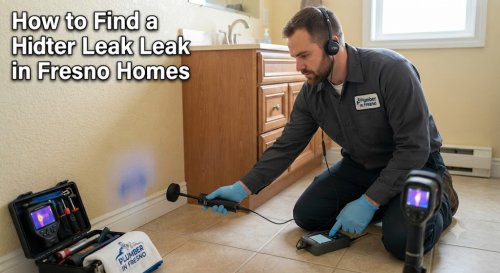
Non-Invasive Acoustic & Thermal Leak Detection:Plumbers deploy acoustic listening discs, ground microphones, and thermal imaging cameras to pinpoint the rupture behind walls or under concrete slabs without unnecessary demolition.
-
Controlled Access & Isolation:Technicians open a precise, minimal access point through drywall, ceiling plaster, or concrete using core drills and drywall saws.
-
Pipe Section Removal:The fractured, corroded, or split pipe section is cleanly cut away using specialized close-quarter pipe cutters.
-
Permanent Pipe Replacement:Plumbers install high-grade Type L copper or cross-linked polyethylene (PEX-a) using commercial press fittings (ProPress), expansion sleeves, or silver brazing to ensure permanent, leak-free joints.
-
Hydrostatic Pressure & Safety Testing:The main water supply is reopened, air is purged, and the repaired line is monitored under sustained hydrostatic pressure to verify structural integrity.
-
Disinfection & Workspace Cleanup:The work area is sanitized, dried, and prepared for necessary structural dry-out and drywall patching.
Professional Equipment Used for Leak Detection & Repair
-
Acoustic Leak Detectors: Amplify the sonic frequency of pressurized water escaping through pipe fractures deep underground or inside wall cavities.
-
FLIR High-Resolution Thermal Imaging: Visualizes minute surface temperature differentials caused by hot or cold water pooling behind wallboards or beneath tiled floors.
-
Electromagnetic Pipe Locators: Map the exact depth and trajectory of metallic and non-metallic water lines beneath yard turf and foundation slabs.
-
ProPress Hydraulic Joining Systems: Crimp copper and stainless steel fittings with multi-ton hydraulic force, creating flame-free seals without open torches in tight, flammable structural cavities.
-
Sub-Slab Concrete Core Drills: Enable clean, surgical penetrations through foundation concrete for direct slab leak repairs.
Repair Timelines
+--------------------+---------------------------------------+------------------+
| Severity Level     | Description of Work                   | Estimated Time   |
+--------------------+---------------------------------------+------------------+
| Exposed Pipe Break | Sink supply, crawlspace, or attic cut | 1 to 2 Hours     |
| In-Wall Rupture    | Drywall access, copper/PEX splice     | 2 to 4 Hours     |
| Sub-Slab Rupture   | Acoustic trace, concrete breakout/fix | 4 to 8 Hours     |
| Main Yard Line     | Trenching/trenchless service pull     | 4 to 8 Hours     |
| Whole-House Repipe | Complete PEX conversion replacement   | 1 to 3 Days      |
+--------------------+---------------------------------------+------------------+
Cost Factors in Pipe Repair
Plumbing repair costs vary depending on the severity of the problem, accessibility, materials required, emergency service, property type, and local labor rates.
-
Location and Accessibility: An exposed pipe break in a basement or garage is faster to repair than a burst line buried beneath a structural concrete slab or routed inside a two-story exterior wall.
-
Extent of Replacement (Spot Repair vs. Repipe): Splicing a 12-inch section of failed pipe resolves an isolated freeze break. However, if the burst occurred because entire copper or galvanized runs are heavily corroded, a partial or whole-house PEX repipe is often the only permanent solution.
-
Emergency Dispatch Timing: Immediate response during late nights, weekends, or major holidays may carry standard emergency dispatch rates.
-
Restoration and Code Requirements: Permitting fees, pressure regulator installation, and drywall/concrete restoration factors into overall project scope.
Hidden Truths Homeowners Should Know
-
A Small Leak Precedes a Massive Burst: Major line blowouts are often preceded by microscopic pinhole seeps that corrode exterior pipe walls over months.
-
Quick DIY Patches Will Fail: Slip clamps, rubber sleeves, and epoxy putties are temporary emergency bandages intended only to hold until a plumber arrives; they cannot withstand long-term hydraulic cycling.
-
Insurance Requires Mitigation: Most insurance policies cover sudden water damage, but they can deny claims if the homeowner failed to turn off the water promptly or neglected known leaks.
-
Pinhole Leaks in One Spot Signal System-Wide Wear: If a 30-year-old copper line develops a pinhole leak from hard water, the surrounding plumbing lines are usually degraded to the same thinness.
-
Undetected Slab Leaks Damage Foundations: Water escaping beneath a concrete slab erodes supporting soil, leading to foundation cracking, settling, and costly structural movement.
15 Common Mistakes Homeowners Make
-
Hesitating to turn off the main water valve while searching for the leak location.
-
Leaving garden hoses connected to outdoor spigots during freezing winter nights.
-
Ignoring dripping pipes or small water stains on ceilings.
-
Using open-flame blowtorches to thaw frozen pipes inside walls, creating a fire hazard.
-
Operating high-draw appliances (washing machines, dishwashers) on damaged lines.
-
Permitting water pressure to remain above 80 PSI without a working pressure regulator.
-
Attempting to solder live, wet water lines without proper draining tools.
-
Hanging heavy clothes hangers or storage items from exposed copper pipes in basements.
-
Covering moldy drywall with fresh paint instead of addressing the hidden pipe rupture.
-
Delaying water extraction, allowing toxic mold to colonize within 48 hours.
-
Hiring unlicensed handymen lacking insurance or proper pressing/soldering tools.
-
Forgetting to insulate exterior pipes, irrigation valves, and attic plumbing lines.
-
Planting aggressive-root trees over municipal water service lines.
-
Discarding damaged pipe sections before insurance adjusters have inspected them.
-
Assuming a low water bill means there are no leaks occurring under the foundation.
Preventive Maintenance Guide
+------------------+-------------------------------------------------------------+
| Season           | Essential Pipe Protection Action                            |
+------------------+-------------------------------------------------------------+
| Fall (Pre-Frost) | Disconnect hoses, shut off spigot isolators, insulate pipes |
| Winter           | Open under-sink cabinets during freezes; drip outer taps    |
| Spring           | Test main PRV water pressure (ensure 50-70 PSI)             |
| Summer           | Inspect irrigation connections, softeners, and supply lines |
+------------------+-------------------------------------------------------------+
-
Install Closed-Cell Foam Insulation: Wrap all exposed copper and PEX lines in unconditioned garages, attics, and outdoor enclosures with 1/2-inch wall foam sleeves.
-
Install an Automatic Water Shutoff Valve: Smart leak detection systems (such as Flo by Moen or Phyn) monitor water flow patterns and shut off the main water valve automatically if a line breaks.
-
Maintain Water Pressure Between 50 and 70 PSI: Test your home’s water pressure annually using an inexpensive hose-bib pressure gauge. Replace the pressure-reducing valve (PRV) if readings exceed 75–80 PSI.
-
Protect Outdoor Backflow Assemblies: Cover outdoor irrigation backflow preventers with insulated fiberglass bags before winter frosts arrive.
-
Exercise Shutoff Valves Bi-Annually: Turn fixture angle stops and the main water shutoff valve twice a year to prevent mineral calcification from seizing the valves open.
Frequently Asked Questions
What should I do first when a pipe bursts in my house?
Immediately shut off the main water supply valve to stop the flow of pressurized water. Once shut off, open cold and hot faucets to drain remaining water, and turn off electricity to any wet areas.
How quickly can a burst pipe cause mold growth?
Mold spores can germinate and colonize wet drywall, carpet padding, and wood framing in as little as 24 to 48 hours following water intrusion.
Will homeowner insurance cover burst pipe repairs?
Most standard homeowners insurance policies cover the sudden, accidental water damage resulting from a burst pipe, as well as necessary demolition to reach the leak. However, the plumbing repair to the pipe itself is typically the owner's responsibility.
Can a burst pipe under a concrete slab be repaired without breaking the floor?
Yes. Depending on the pipe's condition and layout, plumbers can often bypass the broken sub-slab pipe entirely by running a new, seamless PEX line through attic or wall framing, eliminating the need to trench through flooring.
Why do pipes burst during winter freezes?
Water expands by roughly 9% as it freezes into ice. In a closed plumbing system, this expanding ice creates hydraulic pressure between the blockage and closed fixtures, causing the pipe wall to split.
How do plumbers find a hidden pipe leak inside a wall?
Technicians use non-destructive diagnostic tools including acoustic listening devices, moisture meters, and infrared thermal imaging cameras that detect temperature changes caused by escaping water.
What is the difference between Type M and Type L copper pipe?
Type L copper has thicker walls and is the standard requirement for residential interior plumbing and sub-slab installations. Type M has thinner walls and is more prone to early pitting corrosion and bursting in hard water regions.
Can I patch a burst pipe with epoxy or repair tape?
Epoxy putties and repair clamps are temporary emergency measures to slow water flow until a plumber arrives. They do not withstand constant household water pressure and are not code-compliant permanent fixes.
How long does an emergency pipe repair take?
Standard exposed or in-wall pipe repairs typically take 1 to 3 hours. More complex repairs involving underground yard lines or sub-slab breaks generally require 4 to 8 hours.
How can I tell if my main water line from the street has burst?
Signs include an unexplained drop in whole-house water pressure, soggy or sinkhole-prone patches on your lawn or driveway, discolored water, or a water meter that spins constantly while all indoor taps are off.
Why Choose Plumber in Fresno
When an active pipe rupture threatens your property, you need fast, certified local experts:
-
24/7 Rapid Emergency Dispatch: Dedicated emergency plumbers ready to respond across Fresno, Clovis, Madera, and Sanger.
-
Non-Destructive Leak Detection: Advanced thermal imaging and acoustic locating gear to pinpoint leaks with minimal property disturbance.
-
Licensed, Bonded & Insured: Experienced technicians working in strict compliance with California Plumbing Code standards.
-
Upfront Written Pricing: Transparent, comprehensive quotes before any cutting or repair work starts.
-
Complete Piping Solutions: From single emergency splices to whole-home PEX repiping and sub-slab reroutes.