How to Clean a Clogged Faucet Aerator | Plumber
Learn how to clean a clogged faucet aerator with our expert guide. Discover root causes, step-by-step cleaning, and when to call a pro.

The Hidden Cost of Ignoring a Restricted Sink Flow
Turning on your bathroom or kitchen faucet only to be met with a sputtering, twisted stream or a drastic drop in water volume is an immediate source of daily frustration. When you are struggling with how to clean a clogged faucet aerator, the root issue is almost always a buildup of mineral deposits trapped inside the tiny screen mesh of your fixture. Homeowners across Fresno frequently experience this due to regional water conditions, which can quickly choke off water pressure if left unaddressed. Ignoring a sputtering or low-flow faucet forces the internal valve cartridge to work harder against back-pressure, potentially causing premature fixture failure, uneven splashing, and unnecessary frustration during routine kitchen and bathroom tasks.
Root Causes: Why Mineral Buildup Occurs in Fresno Homes
Plumbing fixtures face constant exposure to local environmental and mineral variables. Several distinct factors contribute to frequent aerator clogging in the Central Valley:
-
High Mineral Content: Fresno’s municipal water supply carries high levels of dissolved calcium and magnesium carbonates that precipitate out of solution as water evaporates at the tip of the spout.
-
Aging Distribution Lines: Older neighborhood service lines or aging residential copper piping can shed microscopic scale and rust flakes that travel downstream and get wedged right inside the fine aerator screen.
-
Thermal Precipitation: Hot water usage accelerates the chemical reaction of scaling, causing mineral crystals to bond faster and tighter to brass and plastic aerator threads.
-
Municipal Pressure Variations: Fluctuations in city supply pressure can dislodge loose pipe scale, driving it forward until it packs densely against the aerator mesh.
-
Environmental Dust and Debris: Airborne particulate matter settling on outdoor or heavily used utility sinks can mix with residual moisture to form a crusty blockage.
What Is a Faucet Aerator? Decoding the Mechanism
A faucet aerator is a small, threaded device screwed onto the tip of a faucet spout. It is designed to shape the water stream into a smooth, splash-free column by introducing air into the flow while restricting overall volume to conserve water.
Consider a typical morning routine in a historic Tower District home: you turn on the kitchen sink to rinse a glass, and the water sprays wildly in four different directions because mineral crystals have blocked half of the aerator's internal mesh holes. Water is forced to divert through the remaining open gaps at an erratic velocity. Understanding that the aerator acts as the final microscopic filter before water leaves your plumbing system explains why a simple blockage here can completely ruin water delivery even when the main supply lines are wide open.
Critical Warning Signs: When Your Fixture is Sounding the Alarm
Recognizing the early symptoms of a restricted aerator saves you from unnecessary fixture replacements:
-
Visual Flow Anomalies: A distorted, crooked, or "snowflake" spray pattern where water shoots out sideways instead of flowing downward in a smooth rope.
-
Auditory Clues: A high-pitched whistling or hissing sound when the faucet handle is opened halfway, caused by water forcing its way through restricted mesh openings.
-
Sudden Pressure Drop: A noticeable decrease in water volume isolated to a single fixture, while other taps in the house run at normal pressure.
Ignoring these clues forces the internal mixing chambers to endure unbalanced back-pressure, which can degrade ceramic valve discs over time.
Financial Breakdown: Cost Factors & Investment Realities
Resolving low-flow issues involves various economic considerations depending on whether it is a simple DIY clean or a deeper plumbing intervention:
-
Service Call & Dispatch Fees: Standard flat-rate charges if a licensed professional is dispatched for a multi-fixture pressure diagnostic.
-
Specialty Hardware Replacement: Luxury or designer faucets with integrated, proprietary aerators requiring manufacturer-specific removal keys or replacement cartridges.
-
Hidden Valve Damage: Extra labor costs if neglected mineral scaling has fused the aerator collar permanently to the spout, requiring professional extraction or spout replacement.
-
Whole-Home Filtration Investment: Installing a point-of-entry water softener or scale-prevention system to protect all household fixtures from ongoing mineral damage.
Professional Diagnostic & Repair Workflow
When a homeowner calls a licensed plumber to resolve persistent low water pressure, technicians follow a systematic approach:
-
Step 1: Isolation & Flow Testing: The plumber tests hot and cold sides across multiple fixtures to determine whether the restriction is isolated to a single aerator or linked to a main supply valve issue.
-
Step 2: Non-Destructive Component Extraction: Using specialized rubber-jawed pliers or manufacturer keys, the technician removes the aerator housing without scratching chrome or brushed nickel finishes.
-
Step 3: Internal Cartridge & Line Flushing: The plumber purges the open faucet body to clear out any loose sediment or scale debris lurking upstream before installing a clean component.
-
Step 4: Ultrasonic Cleaning or Replacement: Severely calcified aerators are placed in an ultrasonic cleaning bath or replaced entirely with a code-compliant, high-efficiency flow regulator.
-
Step 5: Final Pressure & Spray Verification: The system is re-pressurized, checked for leaks at the spout threads, and tested for a smooth, aerated laminar stream.
Advanced Diagnostics: The Professional Tool Arsenal
When low flow extends beyond a simple aerator blockage, professional plumbers utilize heavy-duty diagnostic gear to uncover hidden system restrictions:
-
Digital Manometers: Precision pressure gauges attached to hose bibs or fixture supply lines to measure static and dynamic water pressure accurately.
-
Ultrasonic Bath Units: Portable commercial cleaning tanks that use high-frequency sound waves in liquid solutions to blast away microscopic mineral deposits from complex brass fixtures.
-
Thermal Imaging Cameras: Non-invasive infrared devices used to detect hidden flow restrictions, blocked mixing valves, or localized pipe scaling behind walls.
-
High-Definition BoreScopes: Miniature inspection scopes capable of viewing the internal condition of angle stops, supply tubes, and cartridge housings.
Unique Expert Insights: Hard Truths Homeowners Learn Too Late
-
Soaking an aerator in pure industrial muriatic acid without dilution will strip the protective chrome plating right off the brass housing in minutes.
-
Using metal adjustable wrenches directly on decorative faucet finishes causes permanent scratching and gouging that voids manufacturer cosmetic warranties.
-
A low-flowing faucet is not always an aerator problem; failing thermal anti-scald mixing valves under sink basins can restrict hot water flow entirely.
-
Wrapping plumber's tape (PTFE tape) over aerator threads is unnecessary and usually prevents proper seating against the internal rubber washer, causing messy side leaks.
-
Ignoring a slow calcium buildup forces homeowners to eventually replace entire custom designer faucet assemblies that cost hundreds of dollars more than a simple five-minute descaling.
DIY Reality Check: What You Can Safely Fix vs. When to Step Back
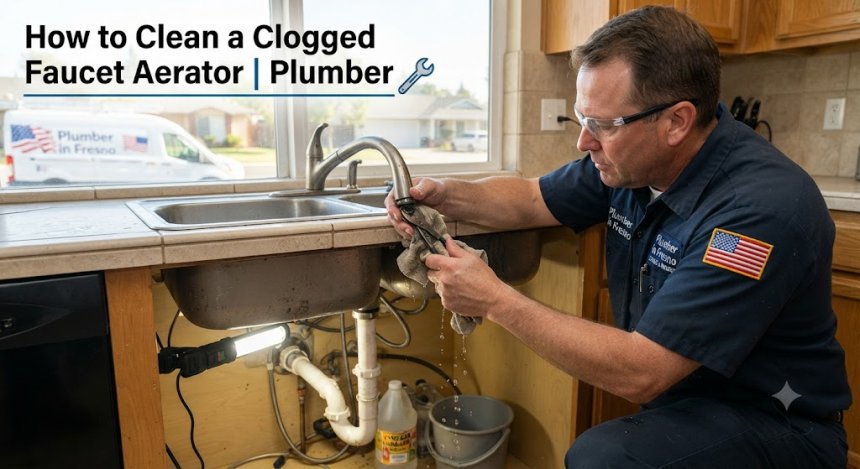
Homeowners can easily handle routine aerator cleaning using basic household items. Wrap the aerator collar with a piece of rubber or painter's tape to protect the finish, gently loosen it clockwise (or counter-clockwise depending on the model) with pliers, and disassemble the internal screens, washer, and flow restrictor. Submerge the parts in a small cup of white vinegar for 30 minutes to dissolve mineral scale, then scrub gently with an old toothbrush before reassembling.
Step back and call a professional immediately if the aerator collar is completely fused to the spout due to severe corrosion, or if removing the aerator does not restore water flow, which indicates a deeper blockage in the supply lines or cartridge. Forcing a stuck aerator can snap the thin brass spout tip, turning a minor cleaning task into an expensive fixture replacement.
Comprehensive Home Plumbing Maintenance Framework
-
Spring & Summer Checks: Inspect outdoor hose bibs for winter cracking, test main shut-off valves for smooth operation, and check under-sink supply lines for early signs of weeping or corrosion.
-
Fall & Winter Preparation: Flush water heater tanks to eliminate bottom sediment, insulate exposed garage supply lines, and disconnect garden hoses to prevent back-pressure freezing.
-
Year-Round Habits: Clean kitchen and bathroom faucet aerators every six months in a vinegar bath, monitor water pressure regulator performance, and avoid chemical liquid drain cleaners that degrade fixture components.
Emergency Protocol: When Immediate Dispatch is Non-Negotiable
Certain plumbing situations require immediate 24/7 professional intervention:
-
Sudden catastrophic failure of a main water supply line or angle stop valve resulting in active indoor flooding.
-
Complete loss of potable water across the entire property.
-
Major pipe ruptures discharging water directly into electrical panels or ceiling cavities.
-
Uncontrollable spraying from a broken faucet fixture that cannot be isolated by the local under-sink shut-off valves.
Frequently Asked Questions (FAQs)
How often should I clean my faucet aerator?
In areas with high mineral content like Fresno, you should unscrew and clean your faucet aerators every three to six months to maintain optimal water flow and pressure.
Can I use vinegar to clean a severely calcified aerator?
Yes. White vinegar is a mild acetic acid that safely dissolves calcium carbonate and mineral scale without damaging metal finishes or rubber washers.
What causes my faucet to spray water in random directions?
Random spraying happens when mineral deposits block individual holes in the aerator screen, forcing water to divert through the remaining open gaps at uneven velocities.
Do all faucets have removable aerators?
Most modern residential faucets feature removable aerators, though some contemporary designer or commercial-style fixtures have integrated, hidden aerators that require a specialized wrench key supplied by the manufacturer.
Why is my water pressure low even after cleaning the aerator?
If cleaning the aerator does not restore pressure, the blockage may be located further upstream in the flexible supply lines, the angle stop valves, or the internal mixing cartridge.
Should I use tools to tighten my aerator back onto the faucet?
No. Hand-tightening is sufficient. Using pliers to overtighten the aerator can crush the internal rubber gasket and strip the delicate threads on the spout.
Why is there black debris in my faucet aerator?
Black flecks usually indicate disintegrating rubber washers from upstream supply hoses or degraded chloramine-resistant seals breaking down inside older shut-off valves.
Can hard water damage my faucet's internal cartridge?
Yes. Over time, mineral scaling can infiltrate the ceramic discs inside the faucet cartridge, causing stiff handles, persistent dripping, and eventual failure of the mixing mechanism