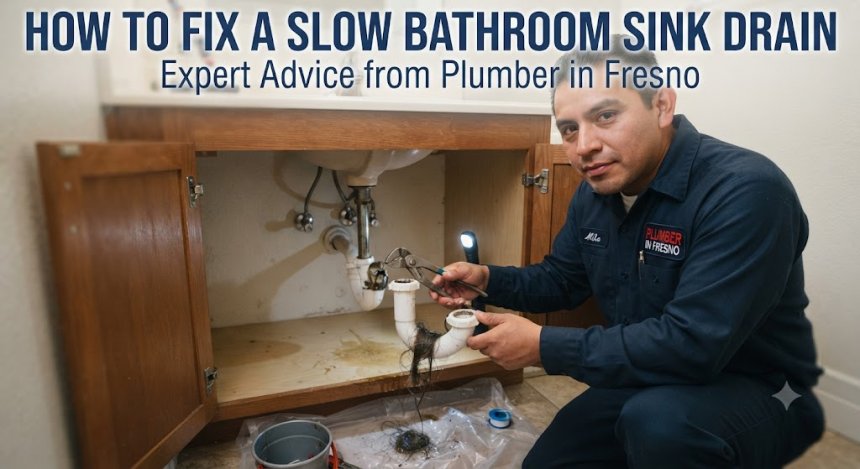
How to Fix a Slow Bathroom Sink Drain
Learn how to fix a slow bathroom sink drain with expert plumbing advice. Discover effective ways to clear clogs and keep water flowing smoothly in Fresno.

The Daily Frustration of Standing Water in the Basin
Leaning over the vanity to brush your teeth in the morning only to watch water pool lazily around the basin stopper is an aggravating start to any day. Dealing with a slow bathroom sink drain is a widespread issue that catches homeowners off guard as organic debris and mineral residues slowly choke the waste pipes.
When toothpaste, hair, soap scum, and calcium accumulate inside your bathroom plumbing, wastewater loses its downward momentum. For residents throughout Fresno and the Central Valley, hard water compounds everyday bathroom use, making minor restrictions a frequent household nuisance. Ignoring a sluggish drain allows organic mass to compact solidly into the P-trap, transforming a quick five-minute fix into an overflowing sink emergency. Understanding how your sink's drainage network operates, utilizing safe clearing techniques, and knowing when to call a licensed professional safeguards your home from water damage.
Critical Warning Signs: When Your Bathroom is Sounding the Alarm
Before a bathroom sink stops draining entirely and overflows across your vanity top, your plumbing system provides subtle sensory cues that indicate a developing blockage.
-
Sluggish Evacuation Rates: If water takes noticeably longer to clear after you turn off the faucet—leaving behind a ring of soap scum—your pipe diameter is severely compromised.
-
Auditory Gurgling: Listen for a faint bubbling or gurgling sound coming from the drain or nearby toilet when the sink empties, which signals restricted air venting in the branch line.
-
Unpleasant Odors: A musty smell or faint organic odor rising from the drain opening indicates that decomposing hair and soap residue are trapped inside the P-trap curve.
-
Multi-Fixture Sluggishness: When running the bathroom sink causes water to bubble or back up into the bathtub or shower, the obstruction has moved past the branch line into the main wet vent.
Root Causes: Why This Problem Occurs in Fresno Homes
Drain restrictions rarely happen by chance; they are driven by a combination of daily human habits, local water chemistry, and the physical architecture of your home's plumbing network.
-
Hair & Soap Scum Binding: Loose hair strands shed during grooming combine with insoluble soap fats and toothpaste, forming a sticky, fibrous binder that clings tightly to pipe walls.
-
Central Valley Hard Water Scaling: Fresno municipal and well water carries high concentrations of dissolved minerals. Over time, calcium and magnesium precipitate out of standing water inside slow drains, creating rock-hard calcification rings.
-
Aging Galvanized & Cast Iron Pipes: Older homes often feature galvanized steel or cast iron drain arms that develop interior corrosion pitting, creating rough surfaces that snag hair and debris much faster than smooth PVC lines.
-
Mechanical Stopper Misalignment: The pivot rod and clevis strap assembly connected to the sink pop-up stopper frequently slips out of adjustment, preventing the stopper from lifting completely out of the water path.
What Is a Slow Bathroom Sink Drain? Decoding the Mechanism
At its core, a bathroom sink drainage system relies on gravity, smooth interior pipe walls, and a properly vented downward slope to transport wastewater from the basin, through a curved P-trap that blocks sewer gases, and into the main sanitary stack. In a healthy system, water and liquid waste flow past the pop-up stopper mechanism and slip swiftly down the tailpiece.
The trouble begins when hair, skin cells, toothpaste, and hard water scale accumulate around the cross-bars of the pop-up plug or coat the interior curve of the P-trap.
Imagine a typical master bathroom vanity in a Fresno home used daily by multiple family members. Over months of use, microscopic hair strands wrap around the vertical pop-up stopper rocker arm inside the drain body. Each subsequent handwashing adds layers of toothpaste residue and calcium scale, cementing the hair into a dense plug. This restriction reduces the effective pipe diameter by up to 80 percent, causing water to back up into the basin because the volume entering the sink exceeds what the restricted pipe can carry away.
Professional Diagnostic & Repair Workflow
When standard consumer fixes fail to clear a stubborn restriction, a licensed and insured plumber executes a systematic, damage-free workflow to restore full flow.
-
Step 1: Non-Invasive Triage & Isolation: The technician checks neighboring fixtures to determine whether the blockage is isolated to the sink branch or part of a larger main line issue.
-
Step 2: High-Definition Video Camera Inspection: For persistent or recurring slow drains, the plumber threads a micro-camera down the waste arm to visually inspect the exact nature and location of the obstruction.
-
Step 3: Transparent, Upfront Options & Pricing: You receive a clear, flat-rate estimate detailing the required mechanical clearing or P-trap service before any physical work begins.
-
Step 4: Mechanical Remediation & P-Trap Service: The technician disassembles and cleans the P-trap, clears the pop-up mechanism, and runs a professional cable auger through the wall stub-out if necessary.
-
Step 5: Flow Verification & Site Cleanup: Water is run at full pressure to test drainage efficiency, followed by a thorough sanitization and cleanup of the work area.
Advanced Diagnostics: The Professional Tool Arsenal
Professional plumbers rely on heavy-duty commercial equipment to solve deep-seated drainage issues quickly and accurately, eliminating guesswork.
-
Mini-Drum Hand-Held Augers: Flexible steel cables with specialized corkscrew heads spin smoothly through tight P-trap curves and branch lines to retrieve stubborn hair clogs.
-
High-Definition Micro-Sewer Cameras: Ultra-thin fiber-optic inspection cameras transmit real-time video feedback to a digital monitor, allowing technicians to spot structural scale and pipe bellies instantly.
-
High-Pressure Hydro-Jetting Units: Operating at controlled pressures, compact hydro-jetters scour interior pipe walls clean of mineral scale and organic sludge, leaving lines in like-new condition.
-
Electronic Pipe Locators: These devices track the exact underground or in-wall path of a compromised drain line from above ground, preventing unnecessary wall or cabinet demolition.
DIY Reality Check: What You Can Safely Fix vs. When to Step Back
Homeowners frequently attempt to fix slow drains with whatever tools are handy, but understanding your limits prevents minor clogs from turning into broken pipes.
-
Safe Homeowner Actions: Removing and cleaning the pop-up stopper assembly, placing a bucket underneath and manually removing/cleaning the P-trap, and using a manual plastic zip-strip snake to pull out near-surface hair clumps.
-
The Danger Zone: Never force stiff metal tools or coat hangers aggressively through old, corroded slip-joint fittings, as you can crack the tailpiece or dislodge rubber washers. Avoid mixing different chemical drain cleaners, which can cause toxic reactions or chemical burns.
-
When to Call a Professional: The moment a clog resists basic P-trap cleaning, or if multiple fixtures back up simultaneously, drop the DIY tools and call a licensed plumber.
Financial Breakdown: Cost Factors & Investment Realities
Plumbing repair and clearing costs vary depending on the complexity of the job. Transparent providers rely on flat-rate pricing rather than deceptive hourly fees.
-
Diagnostic & Dispatch Fees: Covers travel time, professional diagnostic equipment setup, and initial system evaluation.
-
Accessibility & Location: Clearing an open vanity P-trap is fast and economical, whereas accessing complicated wall-mounted or custom vessel sink plumbing requires specialized labor.
-
Severity & Equipment Needed: Simple hand-clearing or P-trap washing is more economical than deploying motorized augers or cutting into drywall for branch line repairs.
-
Repair vs. Replacement Economics: If a P-trap assembly or tailpiece is heavily corroded from hard water, replacing the entire fixture assembly is more cost-effective than patching worn parts.
Unique Expert Insights: Hard Truths Homeowners Learn Too Late
-
Pouring chemical liquid drain cleaners down slow bathroom sinks corrodes metal tailpieces and P-trap walls from the inside out, often turning a simple clog into a costly cabinet leak.
-
Temporary wire coat hanger snaking frequently pushes hair clogs tighter into the wall bend, compacting the obstruction into a solid plug.
-
Unlicensed handymen often overtighten slip-joint nuts or misalign washers, creating hidden slow leaks that rot vanity cabinet bottoms over time.
-
Enrolling in a proactive home maintenance program costs a fraction of a single emergency weekend midnight plumbing dispatch.
-
Small hair clogs are often symptoms of deeper scale buildup inside hard water service areas, requiring comprehensive cleaning rather than quick fixes.
Comprehensive Home Plumbing Maintenance Framework
Proactive seasonal habits and routine upkeep extend the lifespan of your drainage network and prevent unexpected bathroom floods.
-
Spring & Summer Maintenance: Inspect vanity supply lines and P-trap connections for signs of weeping or moisture; test sink stoppers for smooth mechanical movement.
-
Fall & Winter Preparation: Flush water heater tanks to reduce mineral sediment that travels through your plumbing system; check bathroom ventilation fans to control humidity.
-
Year-Round Habits: Install fine-mesh hair catchers over sink drains if hair shedding is common; run boiling water or a natural vinegar-and-baking-soda flush monthly; avoid washing heavy cosmetics or thick pastes down bathroom drains.
Emergency Protocol: When Immediate Dispatch is Non-Negotiable
Certain bathroom drainage crises require immediate professional intervention to protect your home from structural contamination.
-
Catastrophic Sewage Backups: If raw sewage begins backing up out of your bathroom sink, floor drains, or tub into living spaces, evacuate the area and call an emergency plumber immediately.
-
Active Cabinet Leaks: If a sink drain joint is actively leaking water onto electrical outlets or ruining custom wood cabinetry, shut off the water supply angle stops and call for emergency dispatch.
-
Total Household Drainage Failure: When every plumbing fixture in the house refuses to drain, your main sewer line is completely blocked and requires urgent mechanical clearing.
-
Electrical Hazards: If backed-up wastewater approaches electrical outlets near the vanity, shut off power at the main breaker panel right away.
Frequently Asked Questions
How do I clear a slow bathroom sink drain myself?
You can often clear a slow drain by unscrewing and cleaning out the P-trap underneath the sink or by removing the pop-up stopper to pull out trapped hair and soap scum using a small plastic zip-tool.
Are chemical drain cleaners safe for bathroom sinks?
No. Chemical liquid drain cleaners use harsh acids or lye that generate intense heat. This heat can warp PVC pipes, degrade rubber washers, and severely corrode metal tailpieces, leading to expensive cabinet leaks.
Why does my sink drain slowly even after I clean the P-trap?
If a sink still drains slowly after cleaning the P-trap, the blockage is likely further down in the wall branch line due to hard water mineral scale buildup or grease accumulation.
How much does professional sink drain cleaning cost in Fresno?
Professional drain clearing costs vary based on the severity and location of the clog. Most local plumbers charge a flat-rate fee for standard mechanical clearing, which includes thorough testing and cleanup.
Can I use a plunger on a bathroom sink?
Yes, but you must plug the sink's overflow hole with a damp cloth to create an airtight seal so the plunger can apply effective suction pressure against the clog in the P-trap.
How often should I clean my bathroom sink stopper?
You should pull out and clean your bathroom sink pop-up stopper every month to prevent loose hair, soap residue, and toothpaste from building up inside the drain body.
What causes a gurgling sound when my sink drains?
A gurgling sound usually indicates a blocked vent stack or a partial branch line clog. As wastewater forces air down the pipe, it bubbles up through the trap, signaling restricted airflow.
When should I call an emergency plumber for a sink clog?
Call an emergency plumber immediately if your sink is backing up raw sewage, leaking heavily into your vanity cabinet, or causing total multi-fixture drainage failure throughout your home.